
The healthcare industry has gravitated rapidly toward medical plastics as a replacement for metals in surgical instruments for several reasons. Product development investments by high-performance resin suppliers are the driving force. The diverse polymers and polymer formulations they now produce have performance characteristics tailored to different types of medical devices and their uses. Medical grades of the Ultem PEI polymer serve as examples. Injection molding and machining extruded stock shapes made from these materials add economical production of consistently high quality devices and components to the list of benefits the medical polymers provide.
What properties of a medical plastic are important for surgical instruments?
Several factors determine a medical plastic’s suitability as a material for surgical instruments and instrument handles:
- Physical property retention after repeated sterilization cycles is an implicit requirement for reusable surgical instruments.
- Color stability after multiple sterilization cycles is particularly important for color-coded instruments in surgical kits.
- Resistance to all common sterilization methods is essential when marketing reusable instruments to healthcare facilities that use many different systems.
- High strength and stiffness coupled with ductility in a medical plastic can enhance ergonomics, an important factor for surgical instruments and handles.
- Impact resistance or toughness plays a role for instruments exposed to repeated bulk sterilization or are at risk of breakage from pressure applied during procedures.
- Biocompatibility is a key factor for plastics in contact with bodily fluids and tissue for up to 24 hours, and when devices remain in situ for longer periods after surgery.
- Production technology specific to advanced medical plastics – and material forms for each process – support reliable high quantity output with consistent quality.
How does Ultem PEI measure up as a medical plastic for surgical instruments?
Ultem PEI (polyetherimide) is one of several high-performance polymers specified for surgical instruments and instrument handles. The polymer is available in a number of medical grades tailored to different production processes and application requirements. The family of Ultem PEI medical plastics satisfies certain criteria applicable to all polymers suitable for surgical instruments. However, specific Ultem PEI grades offer unique benefits for these applications.
- Property and color stability in common sterilization processes
Depending on the method, Ultem PEI medical grades can tolerate from dozens to several hundred cycles in sterilization systems commonly used in hospitals and clinics worldwide. In e-beam, gamma and EtO systems, the material maintains physical properties very well. Each grade is also available in healthcare colors which show minimal drift after multiple sterilization cycles. This attribute supports Ultem PEI grades as candidates for easily-identifiable color-coded instruments and instrument handles in surgical kits.The Ultem PEI polymer has an exceptionally high glass transition temperature (Tg) or softening point of 218o C (424o F). This attribute, coupled with its hydrolytic stability and low moisture absorption, contribute to its dimensional stability, resistance to deformation and strength retention after multiple autoclave cycles in 134o C (273o F) steam.
Specialty medical grades designated Ultem HU 1000 and Ultem HU 1004 show particularly good property retention and color stability in STERRAD NX, STERRAD 100NX and V-Pro hydrogen peroxide plasma systems compared to other medical plastics.

- High rigidity plus flexibility for ergonomics
Unreinforced or neat Ultem PEI ranks in the upper tier of high performance medical plastics on structural strength or rigidity. Its flexural modulus or stiffness measures 3,450 MPa or 500,000 psi. The polymer retains its rigidity in hot air sterilization processes where surgical instruments and instrument handles are exposed to 180o C (356o F) for 30 minutes or more.
Ultem PEI couples its rigidity with a degree of flexibility that provides a desirable balance for ergonomics in surgical instruments and instrument handles. Its stiffness is an asset for precision control during surgery, while its tensile elongation of 60% affords flexibility to facilitate the hand’s required range of motion during these procedures.
A proprietary blend of PEI and another polymer give Ultem HU 1004 a higher level of impact resistance and ductility than Ultem HU 1000, with only a slight decrease in rigidity. As noted, the formulation retains its ductility and shows minimal color drift in STERRAD NX, 100NX and Pro-V plasma vapor systems.
In addition to instrument handles, surgical devices such as medical forceps that are injection molded from Ultem PEI also benefit from its combination of flexibility and stiffness.
- Biocompatibility for short and longer term contact
Pre-assessed for biocompatibility according to ISO 10993, Ultem HU 1000 and Ultem HU 1004 resins offer two options related to a medical device’s time of contact with bodily fluids and tissue.
Ultem HU 1000 can be specified for instruments where internal contact does not exceed 24 hours. This level of compliance satisfies most surgical instrument applications. Ultem HU 1010, the low melt viscosity grade of HU 1000 developed for injection molding small intricate parts and designs with very thin wall sections, also falls into this category, as does the 30% glass fiber reinforced Ultem HU 2300.
Ultem HU 1004 provides an option for surgical instruments and devices that may remain in the body longer for post-operative procedures longer. The resin complies with requirements for instruments and devices in contact with bodily tissue and fluids for up to 29 days.

- Compatibility with production processes for making surgical instruments
Injection molding and precision machining of stock shapes are the two dominant methods for manufacturing surgical instruments and instrument handles in medical plastics. Ultem PEI resins including the biocompatible HU grades are available in material forms that serve both production methods.
Pelletized Ultem resins are used in the injection molding process, an ideal method for manufacturing high unit volumes that justify investing in production tooling.
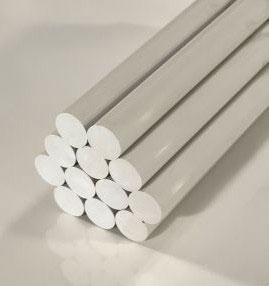
Stock shapes are melt-extruded from pelletized Ultem resin in and serve as the commercially available material forms for machining precision parts. Drake Plastics and its sister company, Genesis Medical Plastics, are examples of processors who specialize in extruding advanced polymers like the medical grades of Ultem PEI in the form of rods, plates and tubes. Both companies also machine precision parts from these materials and have extensive injection molding capabilities as well.
Machining is typically preferred for low- to mid-range production volumes. Injection molders with an in-house machining capability can also post-machine injection molded parts where design features are too complex to be achieved by molding alone.
Tight control of injection molding and extrusion melt process conditions for these high temperature polymers is essential to preserve their properties, avoid degradation and maintain consistent quality. In-mold process conditions must also be monitored and maintained for quality assurance.
The technologies required are available with specialized materials processing companies who invest in – and in some cases design and build – the equipment and control systems to maintain optimum process conditions specific to each resin.
What types of surgical instruments benefit from Ultem PEI properties?
Ultem PEI’s mechanical properties, sterilization resistance, biocompatibility and processing versatility have led to numerous specifications for the material in handles and grips for a range of surgical instruments including:
- Surgical scissors, scalpels, dissectors and forceps
- Arthroscopic and laparoscopic instruments
- Orthopedic surgery tools
Performance attributes specific to Ultem PEI and the Ultem HU grades can be beneficial for surgical instruments. The combination of the PEI polymer’s inherently high rigidity and its level of flexibility provides ergonomic benefits for instruments used in precision and lengthy surgical procedures. While many medical plastics withstand multiple cycles in different sterilization processes, Ultem PEI grades in general stand up to all common methods. Most notably, in STERRAD NX, 100NX and V-Pro media, Ultem HU 1000 and Ultem HU 1004 exhibit minimal color drift and loss of properties after an extreme number of cycles that exceeds the color and property stability of certain other high performance medical polymers.
FAQs for Ultem PEI and Surgical Instruments
Does Ultem PEI stand up to repeated sterilization cycles?
All Ultem grades retain their properties well after sterilization in all commonly used methods. The resin supplier’s testing shows that the material can be sterilized from dozens to hundreds of times, depending on the medium.
What’s different about Ultem HU grades compared to standard Ultem?
Ultem HU 1000 has the same properties as standard Ultem 1000, but is marketed as a medical grade plastic for applications with internal body contact for up to 24 hours. Ultem HU 1004 is the only PEI grade developed for applications in contact with bodily fluids and tissue for up to 29 days. It is a unique blend of polymers and retains color and properties better than other grades in STERRAD plasma sterilization systems.
Are stock shapes available for machined parts in Ultem HU 1000 and HU 1004?
Medical plastics processing specialists offer all Ultem medical grades including HU 1004 in many sizes of machinable extruded rods and plates on a made-to-order basis. Genesis Medical Plastics is an example of a leading company in this field.
Are Ultem resins and shapes including the medical grades available in custom colors suitable for healthcare products?
Ultem resins and shapes are available in many different custom colors. This is a benefit for MDMs who want to differentiate instruments in surgical kits visibly, or to give their products a unique color for marketing or corporate ID purposes.