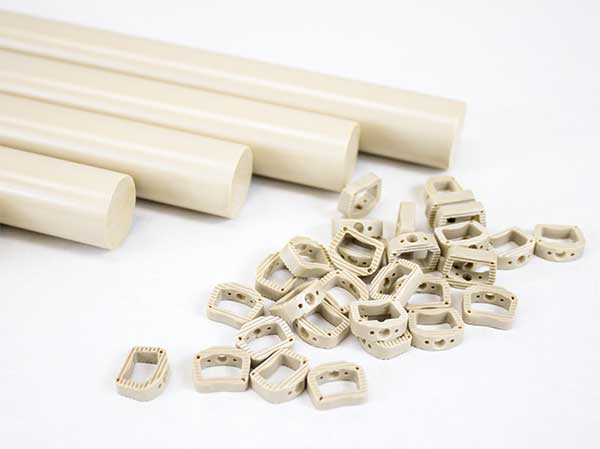
ZFUZE® Therapeutic Biomaterial Comprehensive Overview
Why ZFUZE® Therapeutic Biomaterial?
ZFUZE was developed as a therapeutic biomaterial that has the desirable characteristics of PEEK and titanium while overcoming their shortfalls for these applications. Its patented formulation delivers the following combination of therapeutic benefits for implantable orthopedic devices:
- Early healing
- ZFUZE biomaterial is engineered to provide a pro-healing macrophage environment.t
- Osteoconductivity
- ZFUZE biomaterial supports bone ongrowth and ingrowth, a key advantage over natural PEEK.
- Bone-like modulus
- The modulus of ZFUZE biomaterial is far more similar to bone than titanium, which is extremely rigid by comparison.
- Radiolucency
- Because it is radiolucent, ZFUZE biomaterial allows artifact-free imaging, while titanium is radio opaque.
Prior to the development of ZFUZE technology, this combination of therapeutic benefits was not available in a single biomaterial for long-term orthopedic implants.
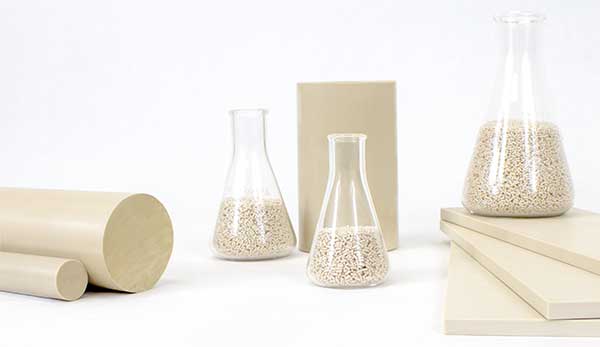
How is ZFUZE Biomaterial Different from Natural PEEK?
- ZFUZE biomaterial has a patented formulation consisting of ceramic zeolites uniformly integrated into implantable grade PEEK resin matrix.
- The resulting biomaterial provides therapeutic benefits that PEEK does not offer.
What are the Benefits of ZFUZE Biomaterial Compared to Natural PEEK?
Without compromising the bone-like modulus and radiolucency of natural PEEK, ZFUZE biomaterial’s patented composition adds two significant therapeutic benefits:
- It has osteoconductive properties that promote bone cell attachment and growth, an attribute that natural PEEK does not have.
- In addition, ZFUZE biomaterial’s unique immunomodulating behavior mitigates fibrous encapsulation and promotes effective early healing.
What are the Benefits of ZFUZE Biomaterial Compared to Titanium Alloys?
While titanium and its alloys are recognized for osteointegrative properties, ZFUZE biomaterial provides several benefits by comparison:
- Modulus far more compatible with bone
- The modulus of ZFUZE biomaterial is more similar to that of bone, while titanium is far more rigid.
- Titanium’s high rigidity can impede healing and create stress shielding and the need for surgical revisions.
- Radiolucency for artifact-free imaging
- Inherently radiolucent, ZFUZE biomaterial facilitates imaging and the ability to monitor healing and assess adjacent structures.
- As a metallic material, titanium has the drawback of radiopacity that interferes with medical imaging methods.
- Mitigation of fibrous encapsulation without surface treatments
- Certain titanium grades use surface treatments to reduce the risk of fibrous encapsulation.
- These surface treatments may pose risks to immune responses, long-term biocompatibility and other factors that can impede their efficacy.
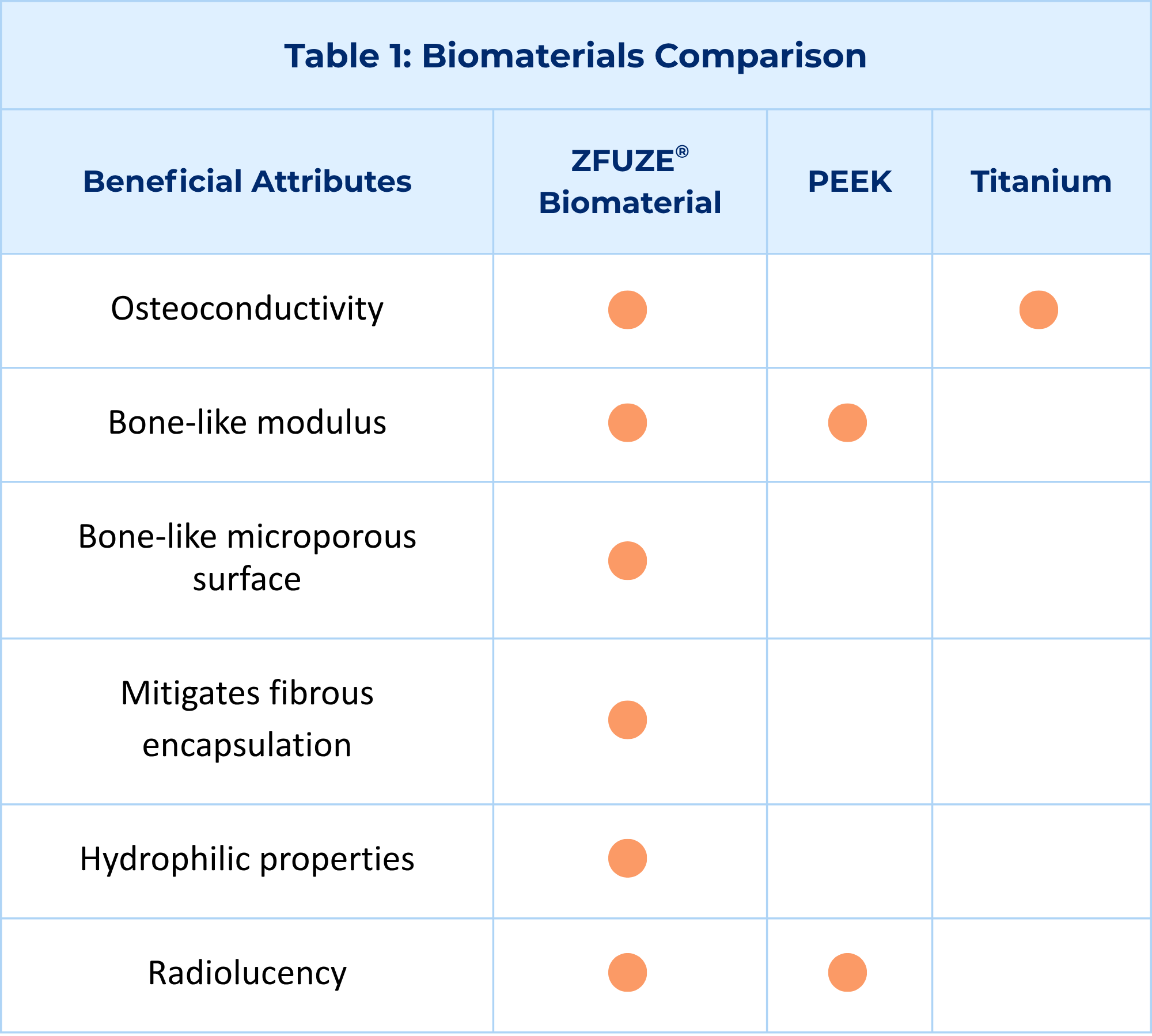
Summary of ZFUZE Biomaterial, Natural PEEK and Titanium Attributes for Implants
Table 1 provides a brief summary that compares the three materials on the major factors related to spinal and other bone-related surgical implants.
The Science Behind ZFUZE Biomaterial’s Performance
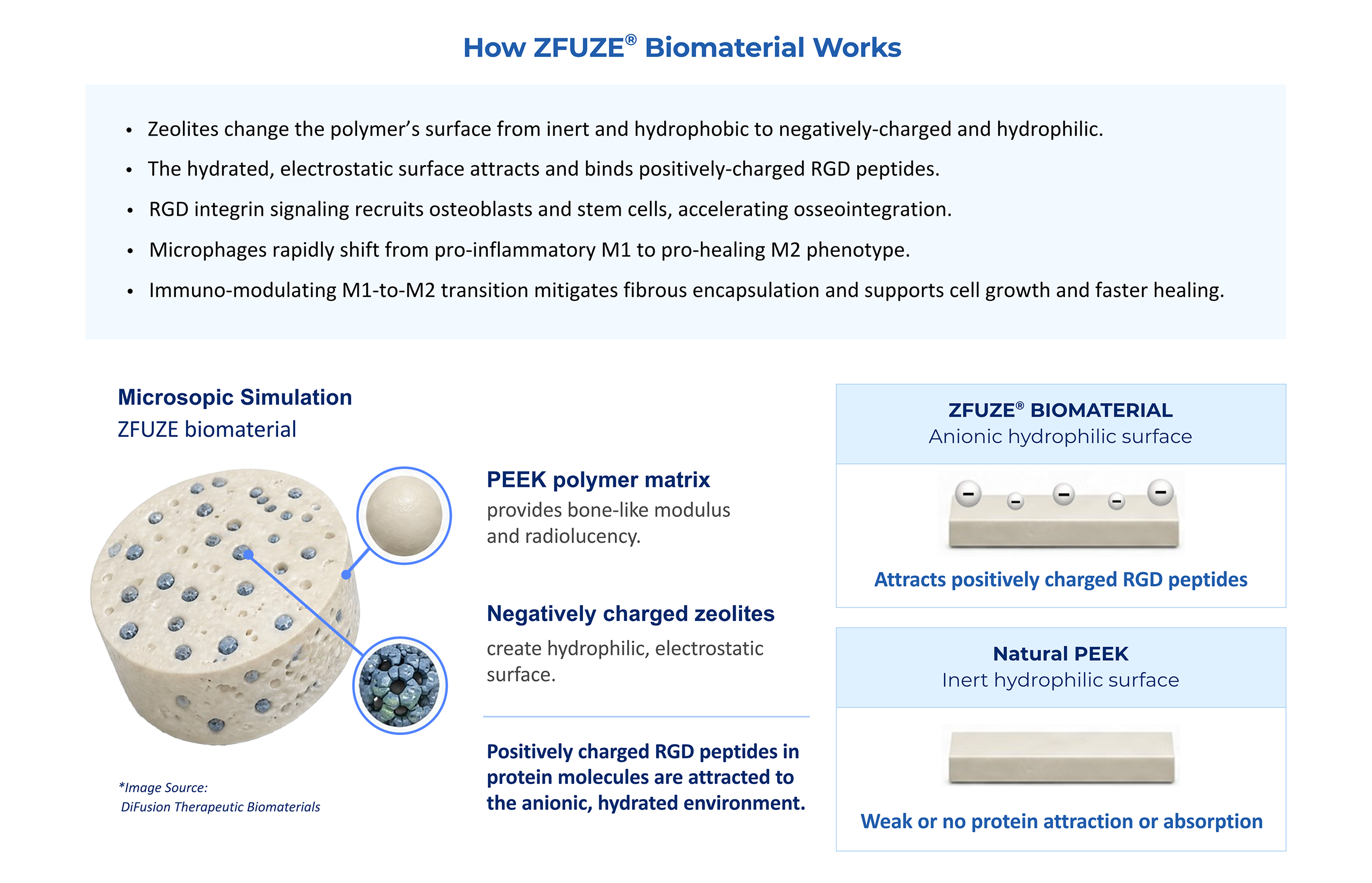
- In its natural state, the PEEK polymer is inert and hydrophobic, attributes that do not readily promote bone on-growth.
- Zeolites in the ZFUZE formulation create a negatively charged hydrophilic surface on implants made from the biomaterial.
- This surface provides an ideal electrostatic substrate for bonding positively charged RGD peptides.
- The resultant bioactive interface attracts bone-forming cells and accelerates osseointegration.
- The microporous structure also serves as an optimal interface for bone cell attachment and growth.
- In addition, the zeolites facilitate a rapid M1-to-M2 transition that mitigates fibrous encapsulation and enables early healing.
How ZFUZE Therapeutic Biomaterial Works
FDA-cleared as an Immuno-modulating Biomaterial
Advances in the science of immune-mediated tissue response has led to a paradigm shift favoring biomaterials that modulate the immune system rather than simply tolerating it. Specifically, immunomodulation as characterized by the shift from the inflammatory M1 state to the pro-healing M2 state is seen as a key driver of post-surgical tissue regeneration.
ZFUZE biomaterial holds a unique position in this regard as the first and only FDA-cleared immuno-modulating biomaterial.
Biocompatibility Documentation for ZFUZE Biomaterial
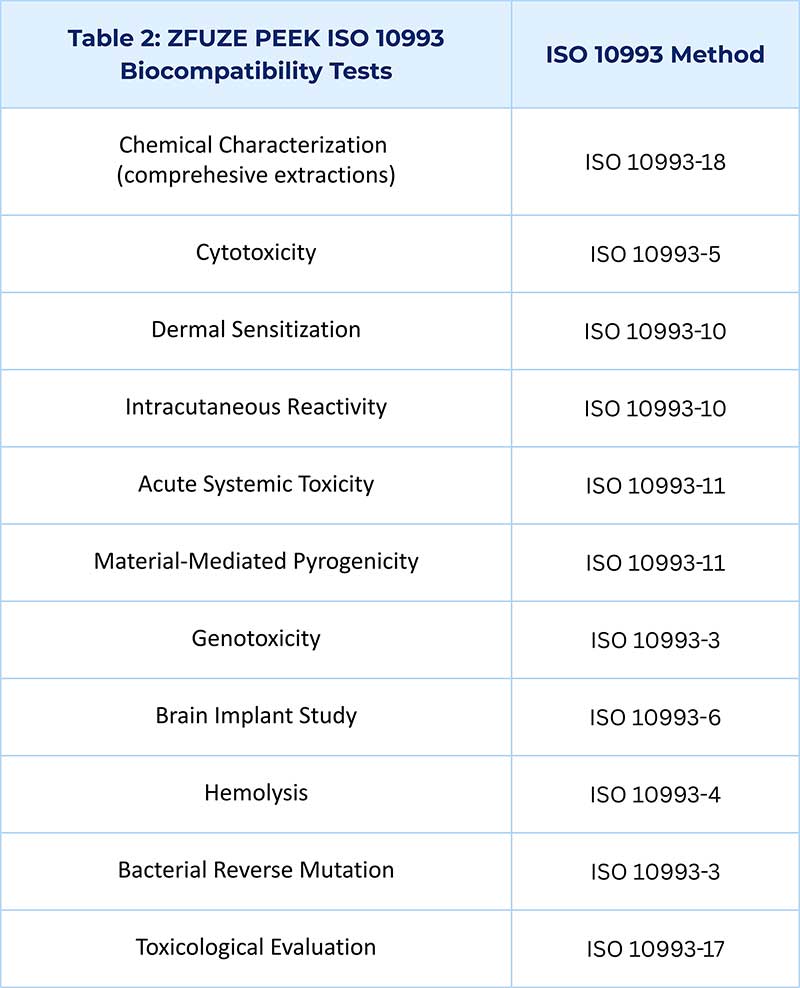
- A ZFUZE FDA Master File with a comprehensive battery of ISO tests (Table 2) and FDA 501(k) submission data are available to support MDMs.
- The ISO 10993 tests were commissioned by DiFusion Therapeutic Biomaterials, the company that developed the ZFUZE composite. Genesis Medical Plastics works collaboratively with DiFusion and can provide access to information and reports that MDMs may require.
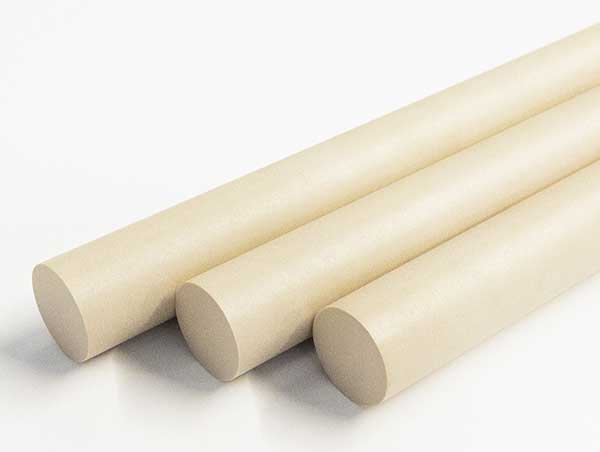
ZFUZE Biomaterial Stock Shapes for Machining
Genesis Medical Plastics extrudes ZFUZE resin into a range of standard rod diameters for machining into precision components. Custom rod diameters and plate in a variety of thicknesses are also available on request.
Machinable Stock Shapes - ZFUZE Biomaterial
- Standard rod diameters: 6mm – 40mm.
- Standard plate thicknesses: 6mm – 25mm.
- Standard width: 305mm; Maximum width: 610mm
- Custom sizes including larger diameter rod and thicker plate available on request.
- Reasonable minimums support product development.
ZFUZE Biomaterial Resin for Injection Molding
To enable production of medical devices in a range of quantities and configurations, Genesis Medical Plastics offers the same ZFUZE grade in the form of pelletized resin for injection molding in addition to stock shapes for machining. Injection molding is typically chosen as devices transition to higher production volumes, while machining is ideal for smaller manufacturing runs and components with complex design features that cannot be molded easily due to tool design constraints.
Genesis Production Capabilities for Implantable Devices
Genesis supports customers’ ability to bring medical products to market with its ISO 13485:2016 and ISO 9001:2015 certification and FDA registration as a device manufacturing facility. In-house capabilities for the production of implantable devices made from ZFUZE biomaterial and a wide range of medical polymers include both machining and injection molding. Genesis also offers prototyping to support product development.
DiFusion-Genesis Alliance Supports MDMs Globally
DiFusion Therapeutic Biomaterials is the ZFUZE™ technology developer and IP owner and focuses on engineering new materials that work with the body to accelerate healing and improve clinical outcomes.
Genesis Medical Plastics is DiFusion’s exclusive manufacturing partner for ZFUZE® biomaterial machinable shapes globally, and serves as DiFusion’s sole commercial partner outside the United States. In addition to shapes, Genesis provides ZFUZE biomaterial resin, machined and injection molded parts.
The two companies have formed a working alliance that provides project support for MDMs and ready access to ZFUZE biomaterial resin, shapes and parts worldwide.
Specifications –
MACHINABLE STOCK SHAPES
Standard rod diameters – mm
- 6mm – 40mm.
Plate dimensions – mm
- Standard thicknesses: 6mm – 25mm.
- Standard width: 305mm
- Maximum width: 610mm
Custom sizes including larger diameter rod and thicker plate available on request.
- Reasonable minimums support product development.
FAQ's About ZFUZE® Therapeutic Biomaterial
What are typical applications for ZFUZE biomaterial?
- The osteoconductive properties of ZFUZE biomaterial are a benefit for devices used in spinal and other orthopedic surgical procedures.
Does ZFUZE biomaterial mitigate fibrous encapsulation that can occur with natural PEEK?
- ZFUZE biomaterial supports immunomodulation, rapidly shifting macrophages from the pro-inflammatory M1 phase to the pro-healing M2 phenotype.
- This transition mitigates fibrous encapsulation and supports bone cell adhesion, growth and faster healing.
Are studies available on ZFUZE biomaterial’s efficacy as an osteoconductive biomaterial?
- Genesis can provide results of several studies done on ZFUZE biomaterial.
- Examples of the efficacy of ZFUZE biomaterial’s performance include:
- A 75-patient retrospective study showing 98.4% lumbar spinal fusion rate at 6 months vs. an average of 68% in 12 months for competitive materials.
- Studies showing a 98% fusion rate at 8 months with 0% device migration (NASS case series).
Does ZFUZE biomaterial have bone-like modulus comparable to natural PEEK?
- A primary benefit of ZFUZE biomaterial compared to titanium is its biomechanical compatibility with bone.
- Standard ASTM testing places the flexural modulus of ZFUZE biomaterial in the same range as implantable grades of natural PEEK.
Are machinable shapes and injection molding resin available in the same ZFUZE biomaterial grade?
- Extruded shapes and resin are available in the same grade of ZFUZE biomaterial, allowing MDMs to more easily transition from machining to injection molding as quantity requirements grow over a device’s life cycle.
Does a change from natural PEEK to ZFUZE biomaterial require a redesign of injection molding tooling?
- Depending on part design and dimensional considerations, tooling changes may not be required, or may be minimal.
- Genesis Medical Plastics has the expertise in processing, tool design and melt flow analysis to advise customers on whether changes are needed and to what extent.