
Medical plastics must provide the right level of biocompatibility based on how the device or equipment is used. Other material selection factors include strength, toughness, and resistance to chemicals that are common in the healthcare environment. But what medical device and equipment designers also should consider is whether a medical plastic is resistant to the high temperatures that their application will encounter.
Thermal resistance is an especially critical factor in selecting a medical plastic for devices that will be subjected to heat during sterilization. It is also an important property for components in equipment that generates high operating temperatures, such as autoclaves.
Why is High Temperature Resistance a Benefit in Medical Plastics?
High temperature resistant plastics offer several benefits for medical device and equipment designers:
- Compatibility with high-temperature sterilization methods
- Devices made from heat tolerant plastics resist warping and loss of ductility and other physical properties after repeated cycles.
- Performance reliability for heat-generating medical equipment
- Medical plastics that resist high temperatures retain their strength and wear-resistance in mechanical components and moving parts that must function smoothly and reliably in equipment such as autoclaves and ovens.
- Design freedom and confidence when replacing metal components
- High temperature resistant medical plastics have a proven history of replacing metals in instruments and devices.
- They allow designers to confidently take advantage of the benefits of color availability, lighter weight, and production economics that plastics offer compared to metals.
Which Medical Plastics are High Temperature Resistant?
Several medical plastics rank as high temperature resistant materials, including ultra-high-performance polymers developed for long-term implantable applications.
The following are the more frequently specified medical polymers that can withstand environments in excess of 170o C or 338o F, often in continuous use applications:
- Polyetheretherketone (PEEK) – PEEK is an ultra high-performance polymer with a glass transition temperature (softening point) of 150o C (302o F). However, its continuous use temperature can exceed that in many applications. Because of its thermal resistance, multi-cycle sterilization tolerance and biocompatibility, its wide application range includes reusable surgical instruments, HPLC components, endoscopy equipment components and dental and surgical implants.
- Polyetherketoneketone (PEKK) – PEKK is a step up from PEEK in properties and in high temperature application possibilities. Its glass transition temperature (Tg) of 165o C (329o F) is higher than natural PEEK. It also provides superior compressive strength. Wear-resistant grades can be used in applications such as miniature gears and bearings where friction and high temperatures are the norm.
- Polyamide-imide (PAI) – Among high temperature resistant medical polymers, PAI has the highest mechanical strength at elevated temperatures. Its Tg measures 275o C or 527o F, well beyond the limits of other melt-processable thermoplastics. Bearing and wear grades are used in functional components in autoclaves and ovens, as well as in precision gears, bearings and bushings in ultra-high speed dental drills.
- Polyphenylsulfone (PPSU) – PPSU’s combination of a Tg of 220o C (428o F) and resistance to degradation in steam and hot water are behind its widespread specification for reusable surgical instruments, sterilization trays and cases, fluid management and monitoring components, and dental/orthopedic tool handles. It can withstand more than a thousand sterilization cycles and still retain much of its strength and toughness.
- Polysulfone (PSU) – PSU is manufactured from linear aromatic chains, compared to PPSU’s phenyl rings. Like PPSU, PSU is tough and impact resistant, but it has a lower Tg (softening point) of 190o C (374o F) and more limited tolerance to different sterilization methods. Where its properties are sufficient, it can be a cost-effective alternative to polyphenylsulfone. Applications include dialysis equipment components, medical housings and sterilization containers.
- Polyethersulfone (PES) – PES has a Tg or softening point of 225o C (437o F), which is higher than PSU and comparable to PPSU. However, its flexural modulus or stiffness is significantly lower than these other sulfone polymers. It’s typically converted into film for membrane and filter applications, including dialyzer membranes. It’s also used in sterilization containers and surgical instruments.
- Polyetherimide (PEI) – PEI offers high mechanical strength and thermal stability up to 170o C (338o F) in continuous use applications. Its Tg or softening point of 217o C is in the range of PPSU, and it provides excellent dimensional stability through temperature swings. Its robust electrical properties make it a good choice for diagnostic equipment and medical device housings, and its strong hydrolysis resistance support its use for sterilization trays.
How Does High Temperature Resistance Factor into Sterilization Compatibility?
High temperature resistant medical plastics are well-suited to instruments exposed to dry heat sterilization, typically done between 160 – 180o C (320-356o F). Materials such as PEEK, PPSU, PSU and PEI also have the hydrolytic stability that makes them tolerant to repeated autoclave and steam sterilization cycles, often preferred over dry heat sterilization.
These high temperature resistant and sterilization tolerant medical plastics are often specified for multi-use medical instruments and devices that reduce waste and increase cost efficiency for medical facilities.
How A Plastics Converter Can Help Transition from Metal to High Temperature Plastics
Injection molding of high temperature medical plastics offers significant production advantages over metals. Device manufacturers can also integrate more complex design features into their designs with injection molding.
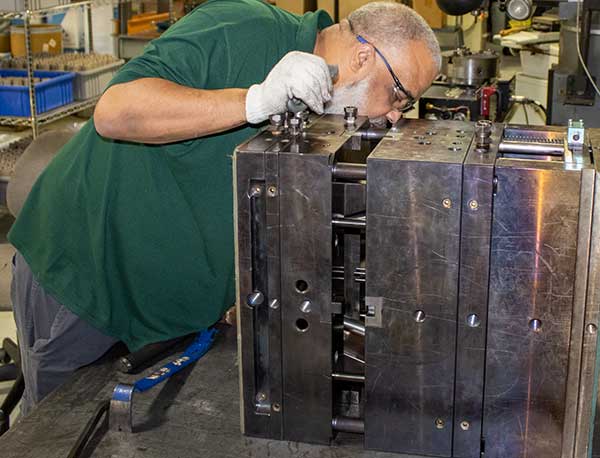
A capable medical plastics injection molder can provide several services not only to help transition from metals, but also to facilitate new product projects in general. Tool design, building, fine-tuning and maintenance services are beneficial in-house capabilities that can expedite progress toward deadlines. In addition, a plastics injection molder with machining capabilities can post-machine especially complex design features into injection molded parts, and provide machined prototypes to facilitate product development.
The plastics converter also plays a key role in getting full value from premium high temperature resistant medical plastics. When evaluating injection molders, these are some factors related to quality management procedures and process technology that can add up to consistently high quality and value from these materials:
- Availability of analytical tools that can define the melt characteristics of the plastic and set the ideal processing parameters that optimize properties of the material and performance of the device.
- Process control systems that monitor and instantaneously maintain those conditions.
- A quality management system that includes dedicated dryers and material handling for each material to avoid cross-contamination.
- Full clean-up of all machine components in contact with polymer melt, to avoid contamination of subsequent production runs from build-up of polymer residue.
- An experienced polymer converter will also maximize yield and minimize material loss with the optimized process conditions, a major consideration for production economics.
FAQs for High Temperature Medical Plastics
Why is it helpful to have a parts supplier who can both injection mold and machine high temperature plastics?
- Having the ability to do both means a more seamless transition from machining to injection molding when quantities justify the tooling investment.
- Machining allows quick turn-around on prototypes for testing, a benefit for new parts as well as when design or material changes are being considered for existing parts.
Are all high temperature medical plastics resistant to repeated sterilization?
- All high temperature plastics tolerate some form of sterilization, but each material is unique in its tolerance of specific methods and the number of cycles it can withstand before losing properties.
- For example, although they are both sulfone polymers, PPSU tolerates multiple cycles in all common sterilization methods and media, while PSU is not recommended for EtO, gamma or plasma systems, or in 134o C autoclaves.
- A parts producer who specializes in high performance medical plastics can provide general sterilization tolerance guidelines and connect designers to their resin suppliers’ technical support resources for specifics.
Do high temperature plastics require specialized injection molding equipment?
- Yes. The design of the screw that moves melted polymer and the capacity of the barrel where the material resides are two key factors that determine uniform melting of the material and the length of time the material is exposed to high process temperatures.
- Excess time at high temperatures can cause burning and degradation which can result in loss of properties and create charred particles that affect the part’s appearance.
Why is process control equipment particularly important for high temperature resistant plastics?
- Sophisticated process control equipment is necessary to monitor and maintain the narrow range of melt temperatures and pressures that yield optimum quality parts. Significant variances can compromise material properties and quality consistency.
- Melt temperature and pressure should also be measured and maintained in the injection molding tool as well, to ensure uniform mold filling and avoid overly hot or cold areas and conditions that can create voids in parts.
What steps can be taken to achieve consistently high quality in medical plastic parts?
- Good quality management practices for processing high temperature plastics include using dedicated dryers and materials handling systems to avoid cross contamination with other resins, doing a full tear-down and thorough cleaning of all equipment components in contact with melted polymer, and avoiding the use of purge compounds that can leave residue and contaminate subsequent runs.