Sourcing a high performance polymer component usually means assembling a chain of some or all of these elements: a resin producer, often a distributor, an extruder, a machine shop and sometimes an injection molder. Every handoff in that chain is a point where material identity, process history and accountability can be lost. A vertically integrated converter removes the handoffs.
What vertical integration actually changes
Genesis converts implantable PEEK and other high performance medical polymers into machinable stock shapes, film, prototypes, and injection molded or precision machined components. The same quality system covers every step.
One material history
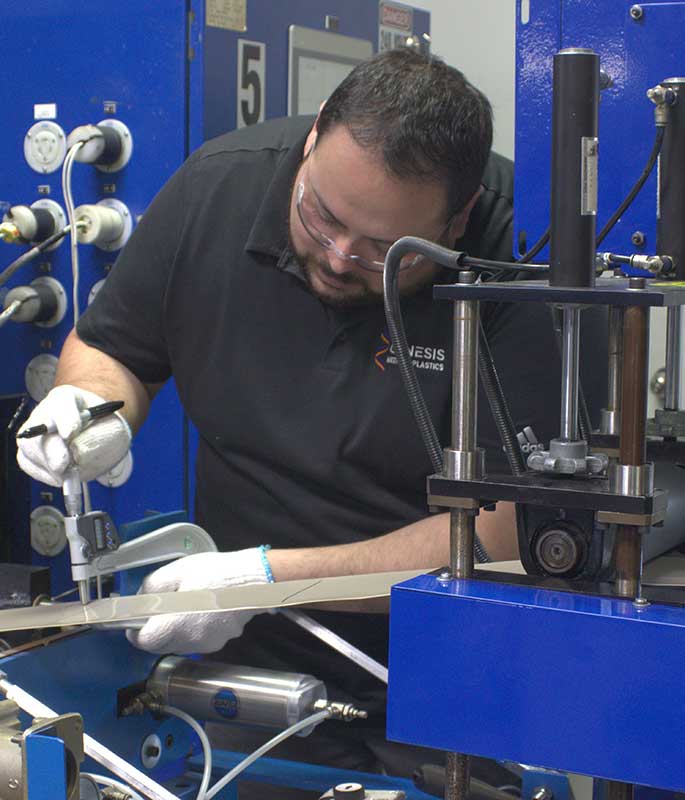
When extrusion, machining and molding happen under one roof, the drying history, thermal history and lot identity follow the part rather than being reconstructed from paperwork at each transfer.
One point of accountability
A dimensional problem on a machined part can originate in the stock shape. When the converter made the stock shape, that is a single investigation rather than a dispute between two suppliers.
One conversion decision
The right process depends on volume and geometry, and it changes over a device’s life. Genesis supplies stock shapes, precision machining, injection molding and PEEK film, so the recommendation is not constrained by what the supplier happens to own.
What to ask a converter
Which grades do you actually convert, and in what forms?
A supplier list is not a capability list. Ask which grades are converted in house and in which forms, not which grades can be sourced.
What is the registered scope of your quality system?
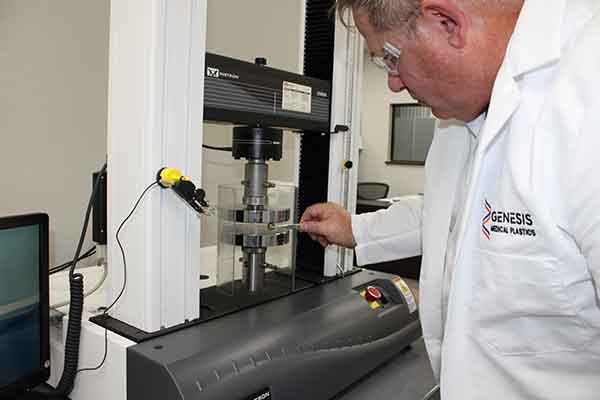
ISO 13485:2016 certification is scoped. Ask what the certificate covers.
What documentation comes with the part?
Certificates of conformance, lot traceability and validation records are what a device manufacturer’s own file is built from.
Can you take the part through its whole life cycle?
Prototype volumes, bridge production from machined stock shapes, then molded production. A converter that can only do one of those forces a supplier change at exactly the point where a change is most expensive.
Genesis certifications
- ISO 13485:2016
- ISO 9001:2015
- FDA registered device manufacturing site
- ASTM F2026 compliant PEEK
- Process validations: IQ, OQ, PQ
See quality and regulatory and certifications.
Tolling and contract manufacturing
If you already own the resin, tolling services convert customer supplied material. Under a tolling agreement title to the material stays with you throughout: Genesis takes in your resin or stock, runs it through a defined conversion process, and returns converted stock shapes, film or finished components.
Tolling is the right structure when you already control the material supply, whether through an existing resin agreement, a qualified lot you cannot deviate from, or a proprietary formulation you do not want to release. You keep the material relationship and buy conversion capability, and you keep the material risk while Genesis carries the conversion risk: yield, dimensional conformance, contamination control and the records of what happened to the material in the plant.
Tolling also suits a smaller program that cannot justify its own extrusion or molding capacity. Material qualified at prototype scale can be converted on the same validated processes at production scale, so scaling does not mean requalifying a material source. How tolling and contract manufacturing compare is set out in toll manufacturing vs contract manufacturing.
If you need a broader scope, contract services covers material sourcing and project support through the device life cycle.
Request a quote
Here is what Genesis needs to provide a quote:
Extruded stock shapes: indicate resin and grade; rod, plate, film or tube; shape dimensions; estimated annual quantity in linear feet or meters.
Parts, machined, injection molded or fabricated from PEEK film: indicate resin and grade, drawing and annual quantity.
FAQs: Choosing a Medical Polymer Converter
What is the difference between a distributor and a converter?
A distributor resells material produced by someone else. A converter changes the form of the polymer, by extrusion, calendering, machining or molding, and owns the process history that results.
Does Genesis work with customer supplied resin?
Yes. Tolling services convert material the customer supplies or specifies.
What quality certifications does Genesis hold?
Genesis is certified to ISO 13485:2016 and ISO 9001:2015 and is an FDA registered site.
Can one supplier handle prototype through production?
Genesis converts the same grades across prototyping, machined stock shapes and injection molding, so a component can move between conversion routes without changing supplier or material history.