
PAEK: Polyaryletherketone Polymers for Medical Devices
Genesis Medical Plastics converts polyaryletherketone polymers into machinable stock shapes, film and finished components at an ISO 13485:2016 and ISO 9001:2015 certified, FDA registered site in Cypress, Texas. This page covers the family and how to choose within it. Each member has its own page with the property detail.
What Is the PAEK Polymer Family?
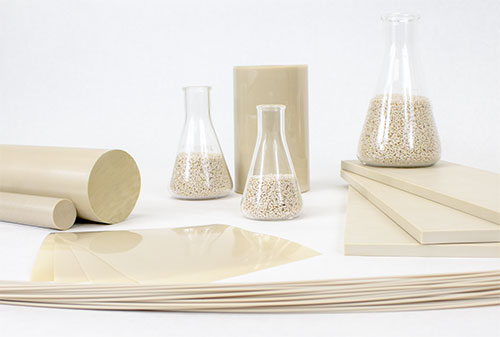
PAEK, polyaryletherketone, is a family of semi crystalline high performance thermoplastics built from aromatic rings linked by ether and ketone groups. The ratio of ether to ketone linkages along the backbone is what distinguishes one family member from another, and it drives the two properties that matter most in selection: glass transition and melting temperature, and therefore processing window and service temperature.
The family includes PEEK, polyetheretherketone, which is the member specified in the overwhelming majority of implantable and reusable device applications, along with PEK, PEKK and PEKEKK.
PEEK dominates medical use for a practical reason rather than a chemical one. It has the longest clinical history, the broadest supply base, and an established material standard for implantable stock shapes in ASTM F2026.
Which PAEK Materials Does Genesis Convert?
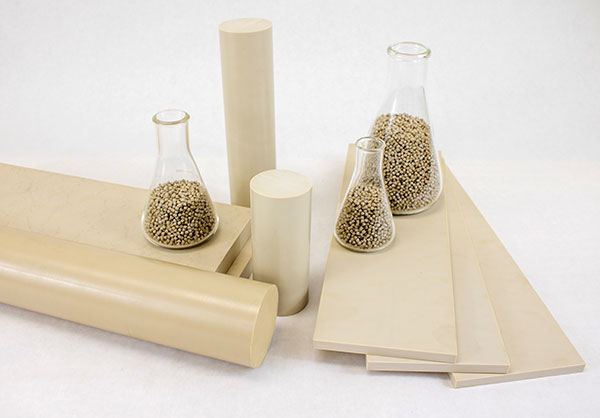
Genesis converts:
- **Genesis PEEK**, implantable grade PEEK stock, ASTM F2026 compliant.
- **Genesis PEEK Film**, calendered from implantable PEEK.
- **ZFUZE PEEK**, a PEEK based biomaterial.
How Do PAEK Grades Differ?
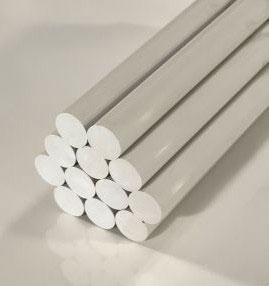
Within PEEK itself, the differences that decide a specification are:
- **Unfilled versus reinforced.** Unfilled PEEK is the standard choice for implantable components and for anything requiring maximum ductility. Reinforced grades trade ductility for stiffness and are largely industrial. For medical applications, unfilled grades meet the requirement in most cases.
- **Implantable grade versus industrial grade.** The polymer chemistry may be nominally similar; the difference is the material’s documentation, contamination control, traceability and compliance to ASTM F2026. An industrial grade rod is not a substitute for implantable stock, whatever the datasheet says.
- **Form and thermal history.** Extruded stock, compression molded stock and injection molded parts do not have identical crystallinity or internal stress, which affects machining behavior and dimensional stability.
- **Biomaterial variants.** ZFUZE is a PEEK based biomaterial developed to modify the material’s interaction with tissue rather than its bulk mechanical properties.
Across the wider family, PEKK and PEKEKK offer higher temperature capability than PEEK, at the cost of a narrower processing window and a much thinner medical supply base and regulatory history. That combination is why they rarely appear in device specifications.
What Is the Biocompatibility of PAEK?
What the page will say, pending confirmation: Genesis PEEK stock is ASTM F2026 compliant, which is the standard covering polyetheretherketone polymers for surgical implant applications. Biocompatibility is evaluated under the ISO 10993 series against the device’s contact type and duration, and that evaluation belongs to the device manufacturer, informed by material data.
Neither a material nor a device gains FDA approval or FDA clearance by virtue of the polymer specified. Genesis Medical Plastics is an FDA registered site.
Selecting a PAEK for Your Application
Four questions settle most selections:
- **Is the component implantable?** If yes, the requirement is implantable grade stock with documented compliance, and the field narrows to implantable PEEK immediately.
- **What is the service temperature?** PEEK covers the range nearly every device application needs. If the answer genuinely exceeds it, the conversation moves to higher temperature family members and to a much thinner supply base.
- **What is the form?** Machined from stock, molded, or film. Genesis converts all three, which means form does not have to drive a change of material supplier.
- **Does the application need modified tissue interaction?** If yes, a biomaterial variant such as ZFUZE is the branch to evaluate.
Each material page carries the property detail. Start with Genesis PEEK for implantable components, Genesis PEEK Film for thin sections, and ZFUZE PEEK where tissue interaction is the design driver.
Why PEEK Dominates Medical Use Within the Family
Three reasons, none of them chemical superiority.
Clinical history. PEEK has decades of implant use behind it, which means a reviewer looking at a submission has seen the material before. A newer family member with better thermal numbers has no such history, and novelty is a cost in a regulated pathway.
A material standard. ASTM F2026 covers polyetheretherketone polymers for surgical implant applications. Its existence gives an engineer something to specify and a converter something to comply with. Most of the family has no equivalent.
Supply and processing breadth. PEEK is available as implantable grade stock, film and molding resin from multiple producers, and it can be machined and molded on standard equipment. Family members with narrower processing windows are harder to convert and harder to second source.
When Would a Program Look Beyond PEEK?
Genuinely rarely, and the honest answer is worth more than an upsell.
Service temperature above what PEEK supports is the one real trigger, and in medical devices that requirement is uncommon outside sterilization edge cases. Where it appears, the higher temperature family members trade processing window and supply breadth for it.
The more common reason to look sideways is not temperature at all but tissue interaction, which is a surface and formulation question rather than a backbone question. That is the branch ZFUZE PEEK addresses.
Request a Quote for PAEK Materials
Tell us the application, the form and whether the component is implantable, and Genesis will recommend a grade and quote it. Request a Quote, or Contact Our Experts. Call 281-255-6848.
FAQs for
What does PAEK stand for?
Polyaryletherketone, a family of semi crystalline high performance thermoplastics built from aromatic rings linked by ether and ketone groups. PEEK, polyetheretherketone, is the family member used in most medical device applications.
What is the difference between PAEK and PEEK?
PAEK is the family. PEEK is the specific member with the ether to ketone ratio that gives it the processing window, service temperature and clinical history that make it the standard choice for medical devices.
Which PAEK polymers does Genesis convert?
Is PAEK biocompatible?
Biocompatibility is a property of a specific material under specific contact conditions, not of a polymer family. Genesis PEEK stock is ASTM F2026 compliant, the standard for polyetheretherketone polymers in surgical implant applications. Biocompatibility evaluation under ISO 10993 is performed against the device's contact type and duration and belongs to the device manufacturer.
Can PAEK polymers be machined and molded?
Yes. Genesis converts PEEK through extrusion into stock shapes, calendering into film, precision CNC machining and injection molding, in one plant under one quality system.