
Orthopedic devices put a polymer under cyclic load, against bone, for years. That narrows the material field quickly. Implantable PEEK is specified in orthopedics because its stiffness sits closer to cortical bone than metal does, it is radiolucent, and it has a long clinical history in load bearing implants.
Why PEEK is specified in orthopedics
Stiffness closer to bone
Metal implants are far stiffer than the bone they are fixed to. That mismatch concentrates load in the implant rather than the surrounding bone. PEEK’s modulus is substantially lower than titanium’s, which is the property most often cited when a design team moves a load bearing component from metal to polymer.
Radiolucency
PEEK does not obscure the implant site on radiographic imaging the way metal does, so healing can be assessed without artifact. Where position still needs to be visible, designs use radiopaque markers rather than a radiopaque bulk material.
Chemical and fatigue stability
PEEK is chemically stable in the body and holds mechanical properties under cyclic loading, which is what a permanent orthopedic implant requires.
Where it is used
Spinal implants
The largest orthopedic application. See spinal implants, what is a PEEK spinal cage and advantages of a PEEK cage versus a titanium cage.
Trauma and fixation
Plates, screws and fixation hardware where load sharing with healing bone matters. See trauma fixation and PEEK as an ideal choice for orthopedic trauma implants.
Arthroscopy and sports medicine
Suture anchors and interference devices, where a radiolucent anchor avoids imaging artifact at the repair site. See arthroscopy.
Joint and prosthetic components
PEEK against titanium
Neither material wins outright, and the comparison is application specific. Titanium brings strength and osseointegration behavior; PEEK brings a modulus closer to bone and radiolucency. Many current designs combine both. See PEEK versus titanium.
Material and conversion from Genesis
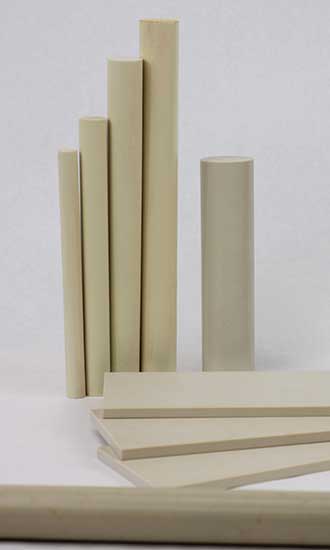
Genesis converts implantable grade PEEK into stock shapes and finished components. Genesis PEEK is ASTM F2026 compliant, which is the standard specification for polyetheretherketone polymers used in surgical implant applications.
For orthopedic components the usual route is precision machining from extruded stock shapes at development and low volume, moving to injection molding as volumes grow. See implantable Genesis PEEK.
Genesis operates an ISO 13485:2016 and ISO 9001:2015 certified quality system at an FDA registered site, with IQ, OQ and PQ process validations.
Request a quote on an orthopedic component
Send the drawing, the grade and the volume. Request a Quote or contact our experts.
FAQs: Implantable PEEK in Orthopedic Applications
Why use PEEK instead of titanium in an orthopedic implant?
PEEK's stiffness is closer to bone than titanium's, and it is radiolucent so the implant site can be assessed on imaging without artifact. Titanium remains preferable where its strength or surface behavior is the deciding factor.
Is PEEK strong enough for load bearing implants?
Implantable PEEK is used in load bearing orthopedic and spinal implants. Whether a specific grade suits a specific geometry and load case is a design question for the device engineer.
What PEEK grades does Genesis supply for orthopedics?
Genesis converts implantable grade PEEK and supplies ASTM F2026 compliant material. Confirm the grade and form for your application with Genesis engineering.
Can Genesis machine finished orthopedic components?
Yes. Genesis provides precision machining from stock shapes it extrudes, and injection molding for higher volumes.